SUB-PROJECT 3 ENHANCED COLLABORATION WITH PARTNERS AND EXPANDED THE RESEARCH AREA ON DURIAN GENETIC DIVERSITY IN VIETNAM
In the context of Vietnam’s rapidly developing durian industry with many opportunities and challenges, research on durian genetic diversity plays a crucial role in conservation, breeding, and sustainable development. In 2025, Sub-project 3 (SP3) under the IUC–QNU Program Phase 1 collaborated with partners to collect durian germplasm samples for providing a completed genetic diversity database of Vietnam.
From the Central Highlands to the South-Central Region
During 2022–2024, Sub-project 3 conducted the analysis of durian genetic diversity in Gia Lai and Dak Lak provinces. From 7–11 July 2025, SP3 collaborated with the Western Highlands Agriculture and Forestry Science Institute (WASI) for collecting 70 durian samples in Dak Nong and Lam Dong provinces, including locations in Dak Mil district, Gia Nghia city, district of Dak R’lap, Da Huoai, Di Linh, Ham Thuan Bac, and Bao Loc city. Through the activities, Sub-Project 3 established collaborative relationships with Da Mi Agricultural Cooperative (Ham Thuan Bac district, Binh Thuan province) and the Lam Dong Research and Experimental Center, thereby expanding the partnership network in research area.
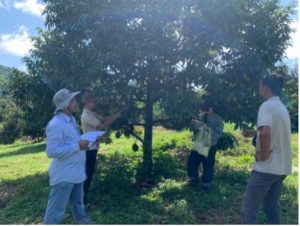
Collection of durian samples at Da Mi Agricultural Cooperative with the support of engineer Nguyen Tien Deu (on right) in Da Mi Commune, Lam Dong Province, on 10th July 2025.
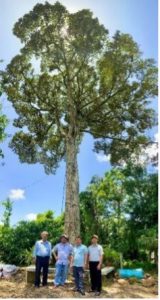
Notably, the research area still preserves many long-standing durian trees, including an individual planted in 1920 in Ha Lam commune (Lam Dong province). These ancient genetic resources hold exceptional value for studying the historical development and genetic diversity of durian in Vietnam
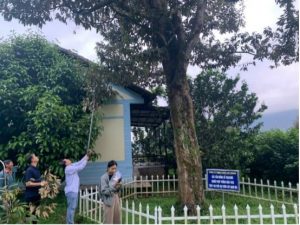
Sampling from a century-old durian tree planted in 1920 at the Nam Nhi Gardent Hotel, Ha Lam commune, Lam Dong province, on 9th July 2025.
Research Networking in the Southern Region
From 30th July to 7th August 2025, SP3 collaborated with Institute of Biotechnology and Food Technology, Can Tho University and the Southeastern Fruit Research Center (Southern Fruit Research Institute, SOFRI) performing the survey and collection durian samples in the Mekong Delta and Southeastern regions.
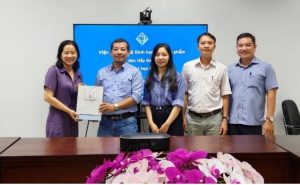
Discussion and collaboration with the Institute of Biotechnology and Food Technology, Can Tho University, on 31 July 2025. From left to right: Assoc. Prof. Dr. Nguyen Thi Pha – Vice Director of the Institute, Dr. Bui Hong Hai – local leader of SP3, MSc-PhD student To Thi Bich Ngoc, MSc. Ho Tan – local team member of SP3, and Assoc. Prof. Dr. Do Tan Khang – Head of the Department of Molecular Biology.
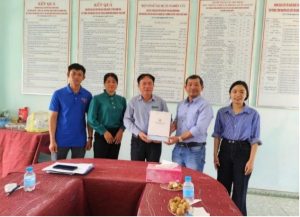
Collaboration with the Southeastern Fruit Research Center, Southern Fruit Research Institute, on 4th August 2025. From left to right in the photo: Engineer Nguyen Tuan Vu, MSc. Pham Thi Muoi – Deputy Director, and MSc. Do Van Thinh – Director of the Southeastern Fruit Research Center, Dr. Bui Hong Hai – local leader of SP3, MSc-PhD student To Thi Bich Ngoc.
With the support of Assoc. Prof. Dr. Do Tan Khang, along with doctoral candidates and master’s students from Can Tho University, as well as technical staff from the Southeastern Fruit Research Center, we collected 72 durian samples across multiple provinces and cities, including Can Tho, Hau Giang, Vinh Long, Tien Giang, Ben Tre, Ba Ria–Vung Tau, Binh Phuoc, and Dong Nai. In addition, we also conducted field surveys and gathered information on cultivation history, origin of durian varieties, and the introduction process and cultivation in local communities. Stories shared by farmers, particularly the century-old durian orchards provided valuable practical documentation, contributing to clarifying the formation and evolution of local durian germplasm.
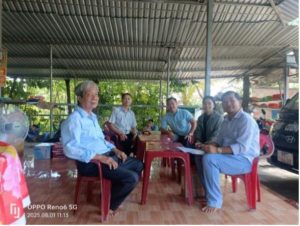
Meeting with teacher Huynh Cong Thong, whose family garden still preserves a 100-year-old durian tree in Tan An hamlet, Tan Loc ward, Thot Not district, Can Tho city, on 1st August 2025.
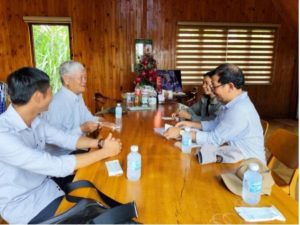
Exchanging with Mr. Truong Van Dao (Ba Dao Durian Ltd. Company) in Bau Nghe Hamlet, Phuoc Tin Commune, Phuoc Long Town, Binh Phuoc Province, on 5th August 2025.
Mr. “Ba Dao” is a successful entrepreneur in durian cultivation, processing, and export for more than 20 years, and has continuously expressed his aspiration to collect, conserve, and develop valuable local durian varieties which are declining day by day in Vietnam.
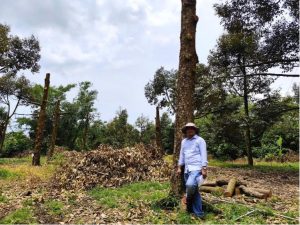
Dr. Bui Hong Hai – local team leader of SP3 with the old ‘Chin Hoa’ durian trees which were cut down due to low economic efficiency in the orchard of local farmer Mr. Nguyen Van Bich in Tan Hanh hamlet, Xuan Bao commune, Lam Ha district, Dong Nai province, on August 6th, 2025.
Survey in the South-Central Coastal Region: Completing the Picture of Durian Diversity in Vietnam
From 21st to 23rd August 2025, SP3 collaborated with the Khanh Hoa Center for Information and Application of Science and Technology (CIAST Khanh Hoa), the Department of Science and Technology in Khanh Hoa Province, for collecting 12 durian samples in Khanh Son and Van Ninh districts. The important information on ecological conditions and the cultivation history of durian in the South-Central Coastal region were also recorded.
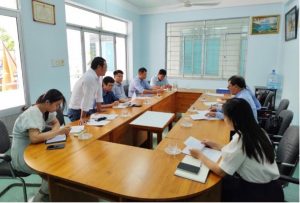
Meeting with the Khanh Hoa Center for Information and Application of Science and Technology (CIAST Khanh Hoa), Department of Science and Technology in Khanh Hoa Province, on 21st August 2025.
The picture of Vietnam’s durian diversity was further completed through remote collaboration with Bung Goi Durian Orchard (Bung Goi hamlet, Phu Quoc, An Giang), farming households in Hoai An district (Binh Dinh province), Ia Chim commune (Kon Tum province), and Nghia Hanh district (Quang Ngai province). The partnership network involving universities, research institutes, research centers, enterprises, and farmers within the framework of SP 3 under the IUC-QNU Programme Phase 1 has been strengthened and expanded. This research will provide important data on gen diversity, origins, and the historical development of durian in Vietnam, thereby contributing to the sustainable development of this important agricultural sector.