Research Highlight: Advancing Smart Window Technology through Thermochromic Nanomaterials
Within the framework of the IUC-QNU project, Hoang Thi Hang (PhD student, SP2) has achieved a significant scientific breakthrough with her recent publication in ACS Applied Nano Materials. Her work presents an innovative approach to designing high-performance thermochromic nanomaterials for energy-efficient smart glazing applications.
The study focuses on vanadium dioxide (VO₂), a well-known thermochromic material that can automatically regulate solar heat transmission by undergoing a reversible semiconductor-to-metal transition at around 68 °C. This transition enables windows to dynamically block infrared radiation at high temperatures while maintaining transparency at lower temperatures, offering strong potential for reducing building energy consumption.
A key innovation of this research lies in the precise control of nanoparticle size, achieved through a scalable hydrothermal synthesis combined with centrifugation-based size selection. This approach allows the production of uniform VO₂ nanoparticles with tunable diameters ranging from approximately 88 to 182 nm. Importantly, the study demonstrates that particle size directly governs optical performance, particularly through the tuning of localized surface plasmon resonance (LSPR).
The results reveal that reducing nanoparticle size leads to:
- A blue shift of the plasmonic resonance (from ~1600 nm to ~1140 nm), enhancing interaction with solar radiation
- A significant improvement in solar modulation efficiency, increasing from 4.2% to 20.7%
- An extension of optical switching behavior toward the visible–near-infrared region, which is critical for real-world smart window applications
Notably, the optimized nanoparticles (~80–100 nm) achieve an excellent balance between high solar energy regulation (ΔTsol ≈ 17.3%) and high visible transparency (≈70.5%), outperforming many previously reported systems.
Beyond technological performance, this work also provides fundamental insights into the size–property relationship in thermoplasmonic materials, highlighting how nanoscale engineering can unlock new functionalities in energy materials.
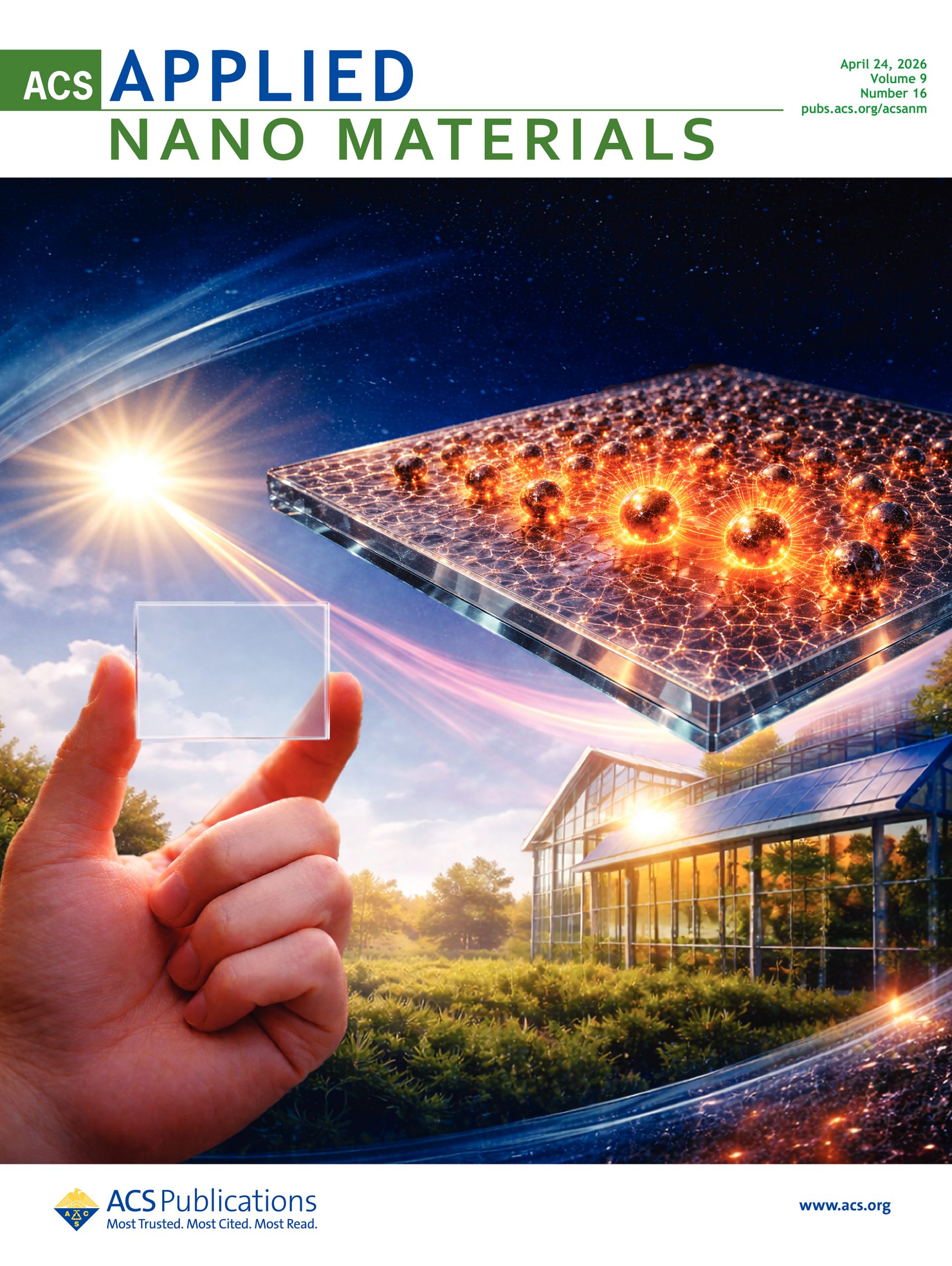
In recognition of both the scientific quality and visual impact of this research, the artwork associated with the study has been selected for the cover of the journal issue, a rare and prestigious distinction.
This achievement exemplifies the strong contribution of SP2 to advanced materials research, international collaboration, and sustainable innovation, reinforcing the role of QNU within the IUC partnership in addressing global challenges such as energy efficiency and climate adaptation.
Reference:
Thi Hang Hoang, Amirmostafa Amirjani, Didier Grandjean, Vuong Minh Nguyen, Kristiaan Temst, Loan Le Thi Ngoc, Ewald Janssens. Size-Selected VO2 Nanoparticles Enabling Tunable Plasmonic and Thermochromic Behavior for Smart Glazing. ACS Applied Nano Material April 11, 2026. Link: https://doi.org/10.1021/acsanm.6c00147