“SHARE YOUR GREEN” JOURNEY: HOW SMALL ACTIONS CREATE BIG ENVIRONMENTAL CHANGE
(IUC) – With the aim of raising environmental awareness and fostering sustainable waste management habits in schools, Quy Nhon University, in collaboration with Ngo May Secondary School and Quang Trung Secondary School, organized a series of activities under the program “Share Your Green. With the message “Small Actions, Big Impact,” the program not only provided practical environmental knowledge but also inspired a sense of responsibility and proactive engagement among students toward a greener future. This initiative is part of Sub-Project 7: Establishing a sustainable institutional waste management system at Quy Nhon University, within the framework of the Institutional University Cooperation (IUC) program between Quy Nhon University and universities in the Kingdom of Belgium.
Overview of the “Share Your Green” event at Ngo May Secondary School
With a focus on enhancing community awareness—especially among students—about the importance of source-based solid waste classification, the program serves as a practical solution to promote environmental protection and shape sustainable lifestyles. By spreading the message of green living, “Share Your Green” gradually nurtures positive habits from an early age, helping students adapt to a modern, eco-friendly way of life. The enthusiastic participation of both students and teachers created a strong ripple effect, clearly demonstrating the program’s effectiveness within the school community.
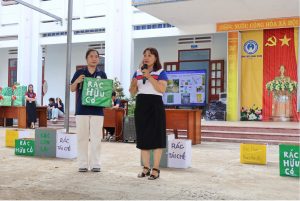
M.Sc. Le Thi Thuy Trang, gave an overview of household solid waste classification.
Through concise and engaging presentations, lecturers introduced key concepts related to household solid waste and proper waste classification in daily life. These sessions helped secondary school students better understand how small individual actions can significantly impact the environment. Building on this foundation, a series of experiential activities were organized, combining both individual and group participation. Interactive games such as “Who’s Faster, Who’s Right?” and “Where Do I Belong?” allowed them to enhance their reflexes while naturally reinforcing environmental knowledge. At the same time, students gained a clearer understanding of waste classification based on its source. Beyond acquiring knowledge, secondary school students actively engaged in discussions, developed ideas, designed creative products, and proposed practical solutions to reduce waste in everyday life. Creative products made from recycled materials by students helped spread powerful messages about environmental protection and sustainable living. Students also eagerly participated in all program activities, demonstrating high levels of enthusiasm and engagement.
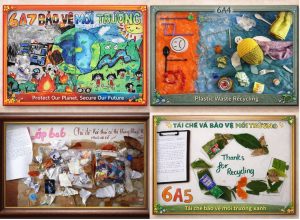
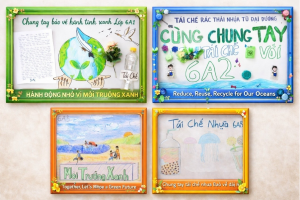
Creative products made from recycled materials by students spread the message of environmental protection and building a green lifestyle.
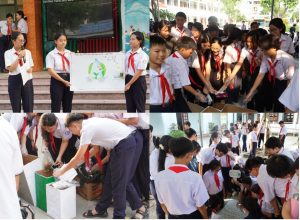
The secondary school students enthusiastically participated in the activities at the program
A highlight of the program was the hands-on activity of waste classification at the source. Students directly sorted waste into appropriate bins, reinforcing their knowledge and gradually forming practical habits for real-life application. The integration of knowledge and hands-on experience created a dynamic learning environment, fostering creativity, teamwork, and a strong sense of environmental responsibility among students.
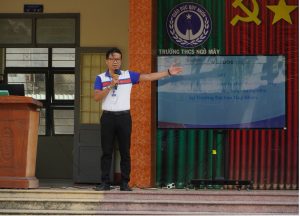
Dr. Dang Nguyen Thoai, Leader of Sub-Project 7, gave a speech at the event.
Speaking at the event, Dr. Dang Nguyen Thoai, Vice Dean of the Faculty of Natural Sciences of Quy Nhon University and Leader of Sub-Project 7, emphasized the crucial role of education in shaping environmental awareness among younger generations. According to him, simple daily actions—particularly waste classification at the source—serve as the foundation for long-term sustainable change. He also expressed his appreciation for the active participation of students and extended his gratitude to teachers, students, and partner organizations for their collaboration in organizing the program. He hopes that the message of green living will continue to spread widely throughout the community.
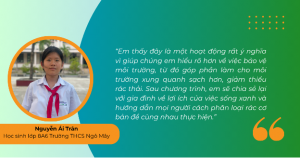
As the program concluded, “Share Your Green” left a lasting impression on students’ awareness and behavior. From foundational knowledge to practical activities, the program has contributed to fostering environmentally responsible habits from an early age. The “green seeds” planted today are expected to grow and spread, creating positive and sustainable impacts within the community—true to the spirit of “Small Actions, Big Impact.”
Nguyen Quy – QNU IUC SP7