Application of Artificial Intelligence (AI) in Training and E-learning
Abstract: Digital transformation has become an inevitable trend in higher education. In response to this development, Quy Nhon University (QNU) has progressively promoted the adoption of advanced technologies in teaching, learning, and scientific research activities. In line with its development strategy for the period 2025–2030, the University organized a scientific workshop entitled “Application of Artificial Intelligence (AI) in Education and E-learning” on January 31, 2026. The workshop served not only as an academic forum for experts and lecturers to exchange knowledge and share experiences, but also clearly demonstrated QNU’s commitment to improving educational quality and meeting the demands of educational innovation in the digital era.
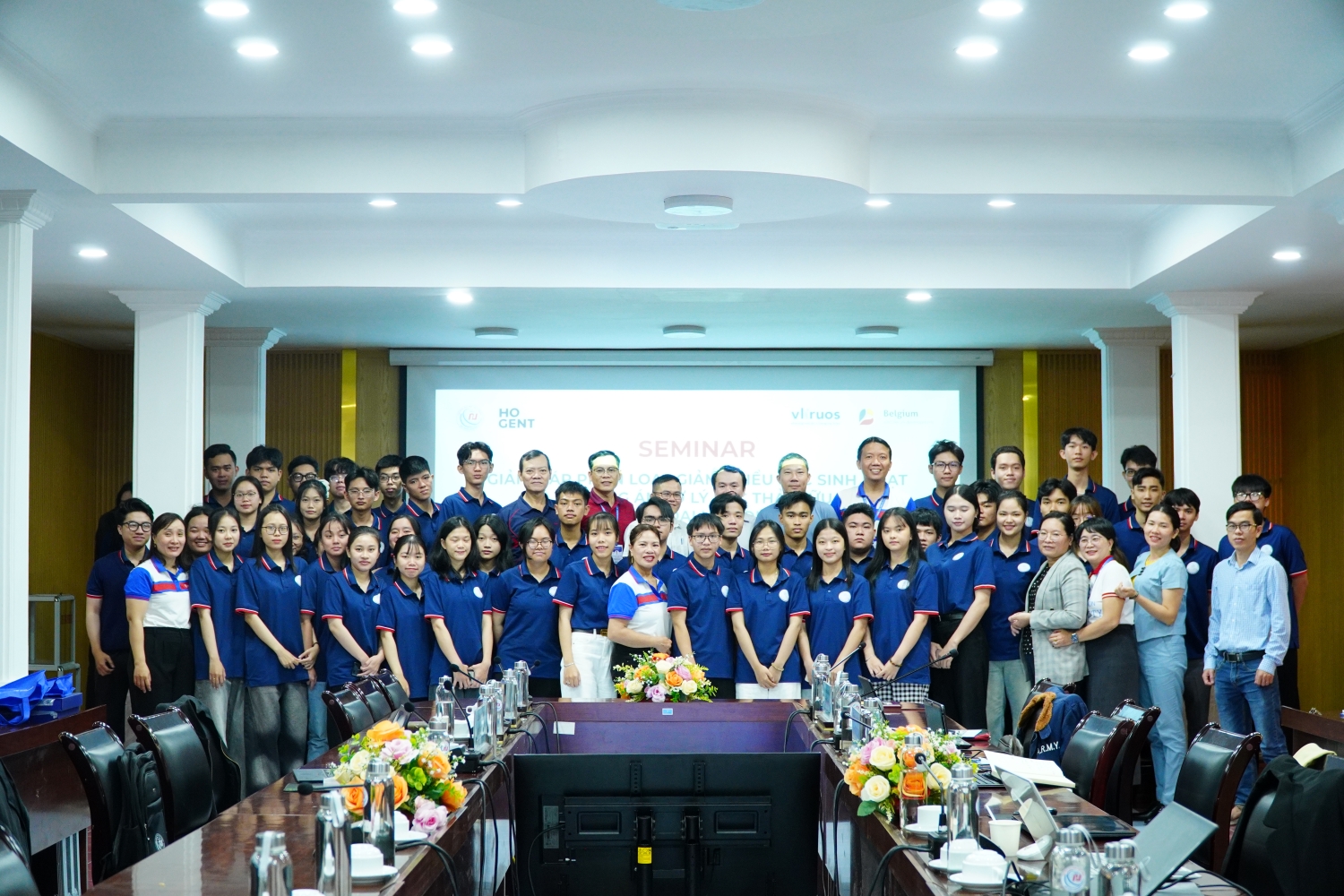
The workshop was organized within the framework of Project 6 of the IUC-QNU Program
The workshop was organized within Project 6 of the IUC-QNU Programme, aiming to operationalize the strategic objective of strengthening Quy Nhon University’s capacity in E-learning, digital libraries, and the development of digital services for students. At the same time, the event represented a meaningful initiative contributing to the effective implementation of the University’s Digital Transformation Plan for the period 2025–2030.
In a context where digital technologies are reshaping higher education, the workshop functioned not only as a strategic implementation activity but also as an important academic forum for experts and lecturers to discuss solutions for improving educational quality. The workshop was supported by Project 6 of the IUC-QNU Programme with the participation of a network of prestigious Belgian universities, including KU Leuven, Hasselt University, Ghent University, the University of Antwerp, HOGent University of Applied Sciences and Arts, and VIVES University of Applied Sciences. This collaboration provides valuable international academic resources and enables the University to access the latest trends in educational technology.
Quy Nhon University’s vision of becoming a smart university.
According to Assoc. Prof. Dr. Doan Duc Tung, President of Quy Nhon University, the University aims to develop into a smart university within the next five years. This objective has been clearly articulated in the University’s development strategy as well as in the Resolution of the Party Congress for the 2025–2030 term.
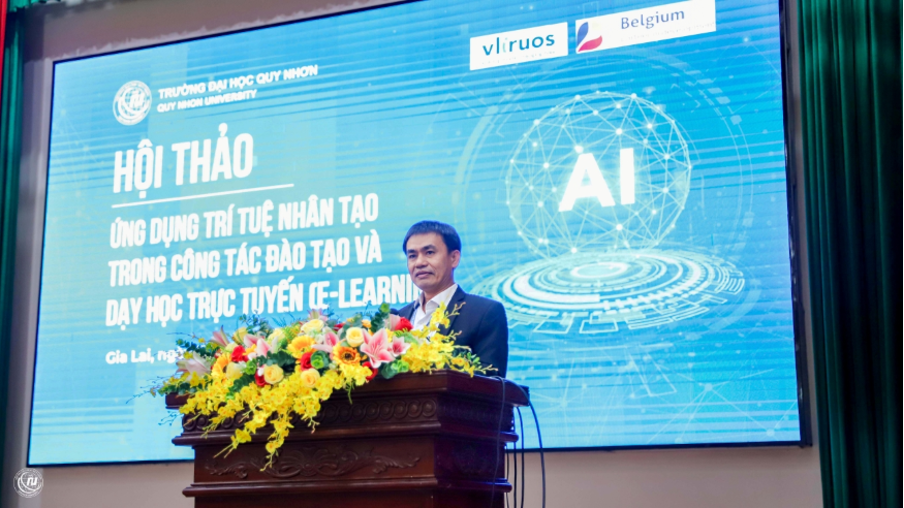
Assoc. Prof. Dr. Doan Duc Tung emphasized that the adoption of AI must go hand in hand with the promotion of lecturers’ intellectual capacity and creativity.
In recent years, Quy Nhon University has implemented various solutions to realize its strategic objectives, ranging from investing in facilities and technological infrastructure to promoting research and training activities associated with the application of emerging technologies. However, the Rector of the University also candidly acknowledged that although the application of artificial intelligence (AI) at QNU has been introduced in several areas, it has not yet been implemented in a systematic and synchronized manner. Therefore, this workshop holds significant importance as it provides a forum for experts to exchange ideas and share experiences, thereby supporting the University in gradually refining and moving toward a unified and effective model for AI application in education and management.
AI adoption must be accompanied by the enhancement of human capacity and creativity
In his remarks at the workshop, Assoc. Prof. Dr. Doan Duc Tung noted that Vietnam is entering a new era of development in which all sectors, including higher education, are undergoing significant transformation. Universities, together with the nation as a whole, are striving to achieve the strategic objectives established in national development policies.
At numerous national forums, leaders of the Party, Government, and provincial authorities have emphasized the need to transform growth models, accelerate digital transformation, and strengthen infrastructure, with the aim of achieving double-digit economic growth in the coming period. To realize this goal, science and technology, innovation, and digital transformation have been identified as key driving forces playing a decisive role in national development.
From this perspective, Dr. Tung emphasized that in the context of increasing workloads and demands for greater efficiency, the application of artificial intelligence represents a useful solution. AI can significantly support administrative management, teaching activities, and scientific research, thereby enhancing productivity and optimizing time management. Nevertheless, he reaffirmed that artificial intelligence should be regarded as a supporting tool rather than a substitute for human capabilities, particularly in areas requiring critical thinking, ethical values, and decision-making. The effective application of AI must therefore be harmonized with the intellectual capacity, expertise, and creativity of lecturers and students, forming a solid foundation for the sustainable development of Quy Nhon University.
Integrating AI into all university activities
In the context of rapid digital transformation, the integration of artificial intelligence into university operations is not only an inevitable trend but also a strategic direction for Quy Nhon University. AI opens new opportunities to modernize institutional governance, enhance teaching quality, and promote scientific research, while optimizing workflows, saving time, and improving decision-making efficiency.
More importantly, AI encourages lecturers and students to actively engage with knowledge, innovate in learning and working methods, and jointly contribute to building a modern, creative, and adaptive educational environment capable of meeting the demands of development in the digital era.
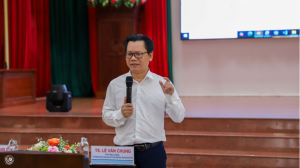
Dr. Le Van Chung, Vice Rector of the School of Computer Science and Artificial Intelligence at Duy Tan University, shared experiences with QNU leadership and lecturers.
During the workshop, Dr. Le Van Chung, Vice Rector of the School of Computer Science and Artificial Intelligence at Duy Tan University, together with Mr. Doan Hoang Duy, M.Sc., Head of the General Administration Office of the same school and Vice Dean of the Faculty of Information Technology at Duy Tan University, delivered several in-depth presentations. Their reports addressed key issues such as the process of designing and implementing AI applications, the development of an AI ecosystem in education, and methods for integrating technology into scientific research and academic management.
Notably, the presentations also shared practical experiences in applying AI across various disciplines, including Business, Management, Engineering, Social Sciences, and Humanities, thereby suggesting new approaches to course design, innovative teaching methods, and student assessment. In addition, the discussion sessions were highly interactive, allowing lecturers to engage directly with experts. These exchanges helped clarify practical challenges and propose feasible orientations and implementation roadmaps for effectively integrating AI into the E-learning system of Quy Nhon University.
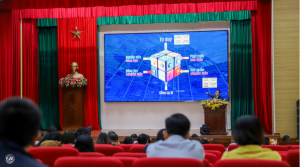
Mr. Doan Hoang Duy, M.Sc., Head of the General Administration Office of the School of Computer Science and Artificial Intelligence and Vice Dean of the Faculty of Information Technology, Duy Tan University.
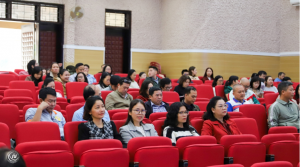
QNU lecturers participating in the workshop.
The scientific workshop “Application of Artificial Intelligence (AI) in Education and E-learning” provided valuable information and practical experiences in applying AI to teaching and learning activities. More importantly, it reaffirmed the institutional commitment and concrete actions of Quy Nhon University in advancing digital transformation.
Building on the insights and exchanges from the workshop, the University aims to further translate these discussions into practical solutions and gradually implement AI in a systematic and effective manner across teaching and management activities. These efforts are expected to enhance the quality of higher education and enable the University to meet the evolving demands of development in the new era.